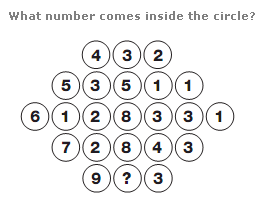
Starting with the numbers in the top row, and following straight lines through the centre of the diagram, subtract the middle number from the top number to give the corresponding value on the bottom row
Answer
:
13
Explanation
:
In each circle, starting at the top left segment, numbers increase, as you move clockwise, by 2 for the upper left circle, 3 for the upper right, 4 for the lower right and 5 for the lower left.
Answer
:
9
Explanation
:
In each square of the diagram, the sum of the numbers is always 22.
Answer
:
40
Explanation
:
Moving from left to right, numbers increase by 2,3,4 and 5.
Answer
:
6
Explanation
:
The numbers in each row and column add up to 15.
Answer
:
4
Explanation
:
Working in columns, the sum of the numbers in each column is always 14.
Answer
:
16
Explanation
:
Starting bottom left and moving clockwise around the triangle, numbers follow the sequence of Square Numbers.
Answer
:
39
Explanation
:
Working from top to bottom, double each number and subtract 1, then 2, then 3 etc
View Answer & Explanation
Answer
:
9
Explanation
:
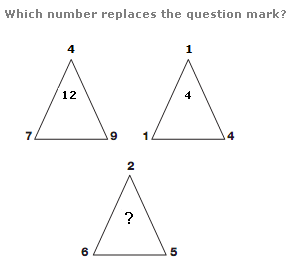
The number at the centre of each triangle equals the sum of the lower two numbers minus the top number
Answer & Explanation
Answer
:
19
Explanation
:
As you move diagonally down, numbers follow the sequence of Prime Numbers
Answer
:
6
Explanation
:
Looking at the diagram in rows, the central circle equals half the sum of the numbers in the other circles to the left and right of the centre.